
Delhi experiences a biting chill with 'cold day' conditions and dense fog, coupled with 'very poor' air quality. The IMD forecasts continued cold weather and potential light rain.
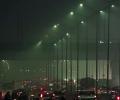
Delhi government mandates 50% work from home for offices and private establishments under GRAP stage three due to severe air pollution. Essential services are exempted.

New Delhi organisers are confident of delivering a 'world-class spectacle' for the upcoming Badminton World Championships, having addressed previous concerns regarding venue cleanliness, air quality, and animal control that marred the India Open earlier this year.

From the air we breathe to the surfaces we touch, our everyday workplace can quietly influence both our physical and mental wellbeing, warns Dr Vikram Vora.

Haryana Chief Minister Nayab Singh Saini met with a World Bank delegation to discuss advancing Artificial Intelligence, digital governance, and skill development in the state. The discussions focused on leveraging technology to enhance citizen services, with plans to showcase Haryana's AI Sandbox globally and develop a dedicated AI model for the state.

Researchers at CSIR-CIMFR have developed India's first mobile Smart Algal Liquid Tree (SALT), an innovative air-purification system using microalgae to absorb CO2 and release oxygen. Designed for polluted urban areas, this compact unit offers a sustainable solution where conventional tree planting is challenging, also providing public utility features.

Concerns over Canadian wildfire smoke impacting air quality and player health for the World Cup final in New York are easing, with forecasts predicting significant rain and a cold front to clear the haze before Sunday's match, though hot and hazy conditions could still pose risks.
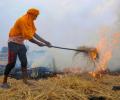
The Commission for Air Quality Management (CAQM) has directed Punjab, Haryana, Uttar Pradesh, and Rajasthan to implement drone-based surveillance to monitor and prevent stubble burning. This initiative aims to counter late-evening burning incidents that evade satellite detection, leveraging drone technology for real-time monitoring, accurate detection, and evidence collection to ensure effective enforcement against agricultural residue burning.
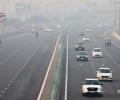
The city's 24-hour Air Quality Index (AQI), recorded at 4 pm daily, stood at 417, making it the worst in the country. On Friday, the AQI level was 396.

The city's air quality dropped to the "very poor" category, with an Air Quality Index of 330 at 10 pm.
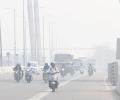
'I think pollution levels have been rising in Delhi for the past 10-12 days. We can feel it in our eyes today. The smog is dense'

Doctors and researchers are increasingly concerned about the potential link between exposure to polluted air during pregnancy and its influence on foetal development, particularly the male reproductive system. While hypospadias, a common congenital abnormality, is multifactorial, endocrine-disrupting chemicals in air pollution are being investigated for their role. Experts call for more research and advise expectant mothers on preventive measures.

The city's Air Quality Index (AQI) stood at 420 at 8 am on Thursday, compared to 426 at 4 pm on Wednesday. The AQI map prepared by the Central Pollution Control Board showed clusters of red dots (indicating hazardous air quality) spread across the Indo-Gangetic plains.
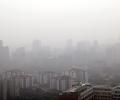
Air quality in Delhi and its suburbs dropped to the severe category again on Wednesday morning, with smoke from post-harvest paddy straw burning in neighbouring states accounting for one-third of the air pollution in the national capital.

The poisonous haze has been causing significant problems for people with existing respiratory issues, according to doctors.

Firecracker bursting till late Sunday night led to a spike in pollution levels amid low temperatures.

The city's 24-hour Air Quality Index, recorded at 4 pm every day, stood at 418, up from 334 the previous day, and it may trigger stringent restrictions under the third stage of the graded response action plan to mitigate hazardous conditions.

The Bandra Kurla Complex area of Mumbai recorded an AQI of 300 and in the Chembur area, AQI of 319 was recorded as 'very poor'.

The central government's Air Quality Early Warning System for Delhi said a "significant improvement in air quality is not likely" owing to slow wind speed, particularly during night time, and contribution from farm fires.

Two-time Olympic medallist PV Sindhu is aiming for a historic sixth World Championships medal, driven by her enduring "hunger towards the game" since starting her senior career in 2009.

The city's 24-hour average AQI was recorded in the 'poor' category at 265 on Saturday as residents flouted the ban on firecrackers in parts of the national capital ahead of Diwali, according to Central Pollution Control Board's (CPCB) data.
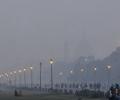
Pollution levels in Delhi during the Diwali period are likely to remain in the higher end of the 'very poor' category in the absence of emissions due to fireworks, the Ministry of Earth Sciences' air quality monitor, SAFAR said.

Delhi experienced a foggy morning with a dip in temperature and improved air quality following recent rainfall. The air quality index (AQI) reached 'satisfactory' levels for the first time in five months.

This time, Delhi saw a sharp improvement in air quality just ahead of Diwali which can be attributed to intermittent rainfall on Friday and wind speed favourable for the dispersion of pollutants.

Air Chief Marshal A P Singh, the IAF chief, has strongly advocated for India to achieve greater self-reliance in unmanned aerial systems and other critical defence technologies, stating, "Technology delayed is technology denied." He stressed the importance of indigenous development to avoid dependency on other countries for components.

Delhiites woke up on Thursday to a thick envelope of smog as air quality in the national capital and in adjoining regions, dipped into severe category again.

The Defence Research and Development Organisation (DRDO) and the Indian Air Force (IAF) have successfully conducted flight tests of the RudraM-II air-to-surface missile, marking a significant milestone in indigenous defence technology.

An improvement in the wind speed November 21 onwards might bring air pollution levels down.

The Maharashtra government has formally acquired the iconic Air India building in south Mumbai for Rs 1,601 crore, completing the transfer of agreements from Air India Assets Holding Company to the state Public Works Department.

The air quality in the national capital remained poor for the sixth consecutive day on Monday with stubble burning accounting for seven per cent of the capital's PM2.5 pollution.

The Badminton World Federation (BWF) has announced its World Tour Calendar for 2027 and 2028, featuring a 35-tournament global circuit. The India Open Super 750 will see its dates shifted to February 2027 and January 2028, while the Syed Modi India International has been downgraded to a Super 100 event. The new calendar also introduces a 3x15 scoring system and extended competition windows to enhance player welfare and global reach.
The Badminton World Federation (BWF) has announced its World Tour Calendar for 2027 and 2028, featuring a 35-tournament global circuit. The India Open Super 750 will see its dates shifted to February 2027 and January 2028, while the Syed Modi India International has been downgraded to a Super 100 event. The new calendar also introduces a 3x15 scoring system and extended competition windows to enhance player welfare and global reach.

A thin layer of toxic haze hung over Delhi in the morning and the overall air quality index stood at 313 at 9 am. It continued its upward trend and was recorded at 337 at 1 pm.

Delhi choked under a thick blanket of smog on Monday, with the Air Quality Index (AQI) settling at 498, which falls in the higher spectrum of 'severe' category.

Delhi's overall air quality index (AQI) stood at 463 at 11.30 am, according to the System of Air Quality and Weather Forecasting and Research (SAFAR).

Experts said while meteorological conditions were "moderately" favourable for dispersion of pollutants, a "very high" number of farm fires in Punjab was the primary reason for "severe" air quality.

The World Cup final offers football's grandest stage a deliciously odd pairing: Argentina, all pulse, fire and Lionel Messi, against Spain, the European champions who appear to treat chaos as an administrative error and have turned control into something close to an art form.

The overall air quality index was recorded at 426 which falls in the 'severe' category, according to data by the Central Pollution Control Board.

According to SAFAR, both stubble burning in surrounding states of Delhi and firecrackers are causing deterioration of air quality in the national capital.

On Thursday, the overall AQI in Delhi was 312 around 8:30 in the morning.
